
Union County Court Records After Arrest
After a Union County arrest, the first public record may be a jail booking entry from the Union County Detention Center. That entry can show a booking number, booking date, charge descriptions, bond status, and arresting agency. It is a custody record. The court record starts when a prosecutor, court, or law enforcement filing opens a case in the Arkansas court system. The 13th Judicial District Prosecuting Attorney handles criminal prosecution for Union County, and formal court case data is searched through the Arkansas Judiciary's public system.
The distinction matters because a booking charge can be broader, shorter, misspelled, or later changed. The jail feed may show a charge as pre-trial or awaiting trial, while Search ARCourts may later show an amended charge, a reduced charge, a dismissal, a plea, or a judgment. For custody and booking details, use the Union County jail inmate records page. For booking photos, use the Union County jail mugshots page. Court records after a jail arrest should be read as the filed case path, not as proof of guilt.
Find Union County Court Records
Union County court records after an arrest are searched in Search ARCourts, the Arkansas Judiciary public case-search portal. The Judiciary describes it as a way to search public case information by participant name or case number for courts using the Contexte case-management system. Public case data can include parties, judge, filings, charges and dispositions, future events, and judgments. Some records or fields are not available online under Arkansas Supreme Court Administrative Order 19, so a missing online record is not always proof that no case exists.
- Start with the jail booking entry. Copy the name spelling, booking date, arresting agency, and each listed charge.
- Open Search ARCourts and search by participant name. Try last name first, then add the first name if results are broad.
- If a court-style number appears, search by case number. Union County criminal circuit cases often use a format that begins with 70CR.
- Open matching cases and compare filing date, county, charge text, case type, and party name before relying on the result.
- For sealed data, older files, unavailable documents, or unclear matches, contact the Union County Circuit Clerk.
The Union County Circuit Clerk page names Cheryl Cochran-Wilson as clerk and lists the courthouse office at 101 North Washington, Suite 201, El Dorado, Arkansas 71730-5661. The clerk's office phone is 870-864-1940, and the page lists office hours as Monday through Friday, 8:00 a.m. to 4:30 p.m., except federal and state holidays other than Columbus Day. The clerk page also links to Public Court Connect, while the Judiciary now directs public case searches through Search ARCourts.
The official Arkansas Judiciary Search ARCourts information page is the best source for portal limits. It explains that some case information is public, some records may include links to filings, and some information is withheld from internet access. For portal support, the Judiciary lists 501-410-1900 option 1 and 866-823-5778. For a specific Union County case, contact the court where the case was filed.
The Arkansas Judiciary's Search ARCourts case search portal is the official starting point for filed Union County case data after a jail arrest.
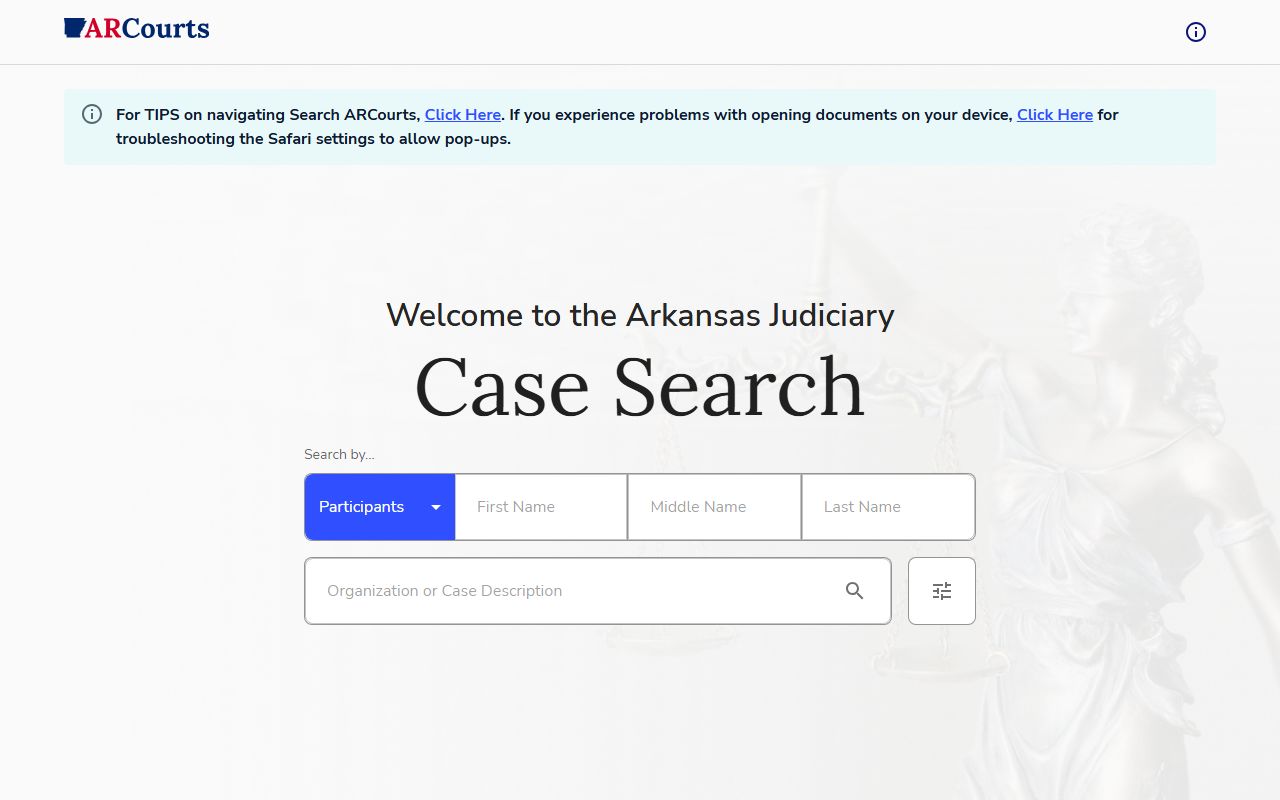
Use the portal result as the court side of the record, then compare it with jail booking data because the two systems update on different schedules.
Union County Court Search Fields
Search ARCourts does not use the Union County jail booking number as its main search key. A booking number belongs to the detention center. A court case number belongs to the court file. If no court case number is known, start with the defendant name from the roster. If the warrant feed shows a court-style number, use that number as a second search route.
| Field Label | Type | Required | Notes |
|---|---|---|---|
| Search by | Tab or selector | Yes | Visible portal options include participant-based searching, and Judiciary documentation also describes case-number search. |
| Participants | Search mode | Optional mode | Use for a defendant or person search when the court case number is not known. |
| Case number | Search mode or field | Optional mode | Use a court case number from paperwork, a warrant, or a case notice, not the jail booking number. |
| Court or county filters | Filter controls | Varies | Use filters to narrow broad name matches to Union County or the proper court. |
| Case type or status | Filter controls | Varies | Useful when a name returns civil, domestic, traffic, misdemeanor, and felony results. |
Search results should be matched with care. A person may have more than one Union County case, a warrant may relate to an older case, and a petition to revoke probation may not look like a new arrest charge. The warrant feed can also show domestic-relations or child-support IDs, which should not be treated as new felony case numbers without checking the court record.
Charges Filed After Arrest
A Union County jail arrest can reach court in several ways. Some lower-level matters begin with a citation or summons and may not involve a jail booking. A warrant arrest can lead to booking and then to a court record tied to an existing case. A new arrest usually starts with an agency report, then the prosecutor reviews the facts and files or continues charges in the proper court. Arkansas uses prosecuting attorneys, and Union County is served by the 13th Judicial District Prosecuting Attorney.
| Document | Who Uses It | What It Does |
|---|---|---|
| Complaint | Law enforcement, prosecutor, or court process | Starts or supports an initial charge, often in lower-court or first-appearance settings. |
| Information | Prosecuting attorney | Formal charging document used for many Arkansas felony prosecutions in circuit court. |
| Indictment | Grand jury | Formal accusation by a grand jury. It is possible but not the ordinary path for most local cases. |
The prosecutor's Union County office is listed at 307 American Road, Suite 114, El Dorado, Arkansas 71730, with phone 870-864-1960. The official staff page lists Prosecuting Attorney Jeffrey Rogers and Deputy Prosecuting Attorney Margaret W. Wynne for Ouachita and Union counties. The prosecutor FAQ cautions that defendants generally should not speak directly with the prosecutor. Represented defendants should use counsel, and court clerks cannot give legal advice.
The 13th Judicial District staff page gives the local Union County prosecutor contact table for criminal-case routing after an arrest.
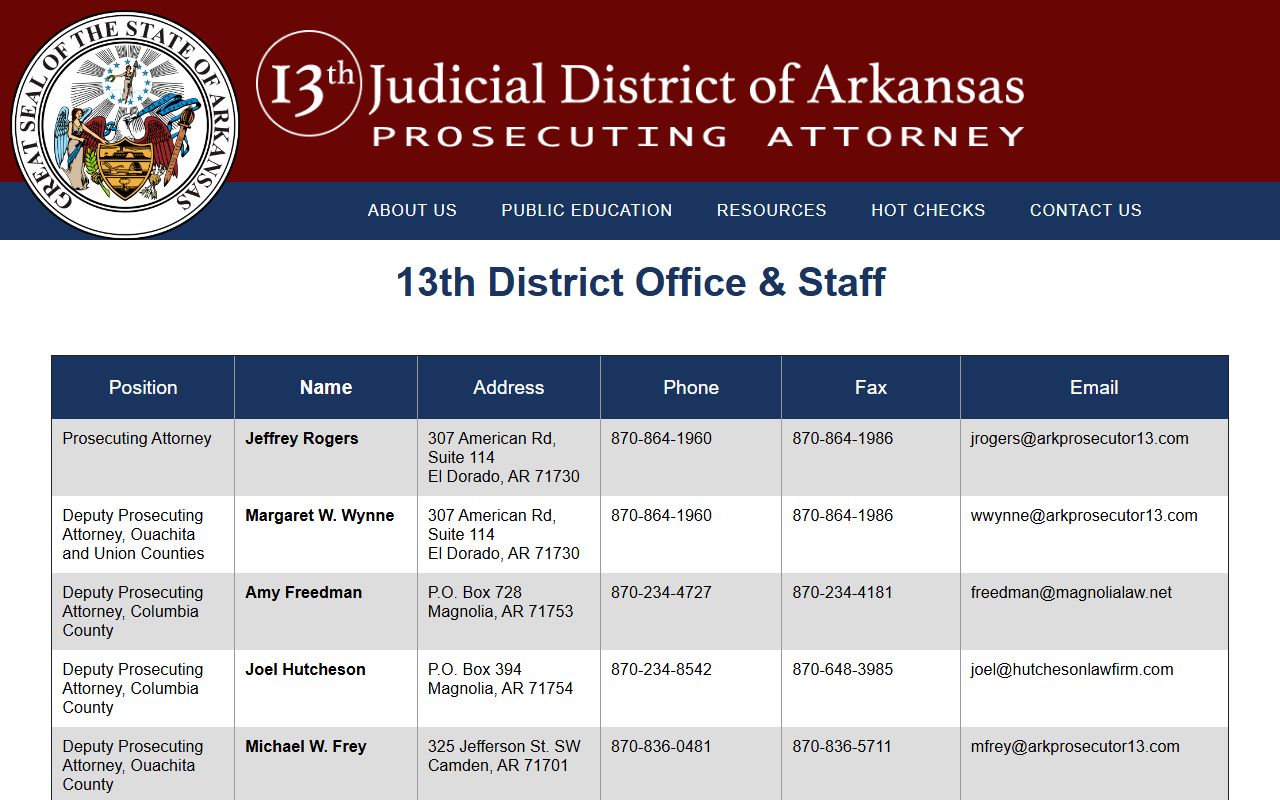
That office is part of the charging path, while the clerk and Search ARCourts are the public routes for reading the filed court record.
Union County Charge Status
Charge status is the bridge between a jail arrest and the court record. The Union County roster has shown charge statuses such as Pre-Trial, Awaiting Trial, and N/A, plus bond-status values such as Active Bond, Posted Bond, Concurrent Bond, Sentenced, and Dismissed by Courts. Those labels are useful, but they are jail-feed labels. The court record is the place to check filed charges, amendments, dispositions, and judgments.
| Status | Plain Meaning | Where to Verify |
|---|---|---|
| Pending or pretrial | The charge is awaiting court action and has not reached final disposition. | Search ARCourts and the Circuit Clerk. |
| Amended | The prosecutor or court changed the charge text, level, or count. | Filed court docket and filings. |
| Reduced | The charge was lowered to a lesser offense or lesser count. | Court disposition and plea records. |
| Dismissed | The charge was ended by the court or prosecutor. | Court order or docket entry. |
| Nolle prosequi | The prosecutor declined to continue that charge. It is often shortened to nolle prossed. | Court disposition entry. |
| Disposition | The current or final outcome of a charge. | Search ARCourts or clerk copy. |
Do not treat a roster label as a final case outcome by itself. One Union County jail charge row may show a bond status that refers to that row only. It may not describe all counts, all cases, or a final court judgment. For the safest match, read the court case, then call the clerk when online data is incomplete or unclear.
Bond After Union County Arrest
Bond information may appear before a full court record is easy to find. Union County roster entries show bond amount and bond status at the charge level, not just one total for the whole person. Inspected bond statuses included Active Bond, Posted Bond, Concurrent Bond, Sentenced, Dismissed by Courts, and N/A. N/A should not be read as a fixed legal answer. It may mean bond has not been set, is not applicable to that row, is controlled by another court order, or is not public in the feed.
| Bond Type | How It Works | Union County Checkpoint |
|---|---|---|
| Cash bond | Money is posted directly if the court or jail permits it. | Call 870-864-1970 before bringing funds. |
| Surety bond | A licensed professional bondsman posts bond for fee or collateral. | Sheriff staff do not recommend a specific bondsman. |
| Personal recognizance | Release is based on a promise to appear. | Depends on a judge or court order. |
| Property bond | Court-approved property may secure release in some Arkansas cases. | Confirm with the court locally. |
| No-bond hold | Release is blocked by no bond, another warrant, a detainer, or another agency hold. | Ask the jail and check the court case. |
A detainer is a hold from another agency. A person can post a Union County bond and still remain in custody if another county, Arkansas DOC, probation or parole, USMS, or ICE has a hold. The sheriff FAQ points users to the Arkansas Professional Bail Bondsman Licensing Board jail phone list for licensed bondsman information, and the jail line is the practical place to confirm current bond status before money changes hands.
Warrants Before Union County Arrest
A warrant can be the event that turns an old court problem into a new jail booking. Union County publishes an official sheriff OCV warrant feed, and the sheriff web app has a Warrants quick link. The sheriff FAQ says the office maintains a copy of its warrant list and that people may contact the office at 870-864-1970 to check warrant status. The warrant feed may show a warrant ID, date issued, age, sex, race, and offense description.
Warrant IDs vary. Some look like sheriff IDs, while others look like court case numbers, such as criminal numbers beginning with 70CR or domestic-relations numbers beginning with 70DR. If the number looks like a court case number, use it in Search ARCourts as well as the warrant feed. The public warrant feed does not show every detail needed for release, so active status, bond, and court date should be verified before anyone appears at the jail or courthouse.
Note: A warrant list can include old entries, and only the sheriff or court can confirm whether a warrant remains active.
Charges Versus Convictions
An arrest and a filed charge are accusations. A conviction is a finding of guilt through a plea, verdict, or other court judgment. This is a core point for Union County court records after a jail arrest because the public may see charge text before any hearing has resolved the case. Pre-trial and awaiting-trial labels should be read as pending status, not as proof that the person committed the offense.
| Point | Charge | Conviction |
|---|---|---|
| Stage | An accusation filed or listed after arrest. | A final or qualifying court outcome. |
| Proof level | Based on probable cause or prosecutor filing choice. | Based on plea, verdict, or legal finding. |
| Where seen | Jail roster, warrant feed, charging document, court docket. | Court disposition, judgment, sentencing entry. |
| Can change | Yes. It may be amended, reduced, added, or dismissed. | Changes only through later court action, appeal, or post-case relief. |
For background or screening decisions, use lawful, compliant processes instead of a casual roster or docket search. A jail record is current custody data. A court record is legal-case data. Neither should be stretched beyond what it actually says.
Sealed Union County Court Records
Arkansas uses a statutory sealing process for many eligible criminal records. Research sources identify the Comprehensive Criminal Record Sealing Act of 2013, A.C.A. 16-90-1401 and following sections, as the general sealing framework. A sealed record is restricted from ordinary public access, but it is not the same as saying the event never occurred for every legal purpose. Eligibility depends on the offense, disposition, prior history, waiting period, and court order.
| Record Treatment | What It Means | Practical Limit |
|---|---|---|
| Sealed | Public access is restricted by court order for eligible records. | Some agencies may retain limited legal access where law allows. |
| Expunged | Often used casually to mean cleared, but Arkansas practice commonly centers on sealing. | Read the exact court order and statute before assuming destruction. |
| Dismissed charge | A charge ended without conviction. | Online traces may remain until a court order or update changes access. |
| Juvenile or protected data | Some records are confidential or withheld from public internet display. | Search ARCourts may omit them under access rules. |
Arkansas FOIA, A.C.A. 25-19-105, generally opens public records to Arkansas citizens during regular business hours unless an exemption applies. Court access also has its own limits. The Search ARCourts information page points to Administrative Order 19, which controls public access and internet restrictions for court records. A person seeking to seal a Union County case should use the court process, not a jail roster request, because the clerk's record controls the court file.
Restricted Court Records After Arrest
Not all Union County court records after an arrest appear on the public internet. Search ARCourts may withhold nonpublic data, protected identities, juvenile matters, sealed records, certain filings, and information restricted by Administrative Order 19. Law-enforcement investigative records may also have separate limits under Arkansas public-record law. The jail roster itself omits many personal details, including date of birth, home address, housing unit, court date, and full physical descriptors.
The Circuit Clerk page lists local copy and certification fees, including 50 cents per page for copies, 5 dollars for certified copies, and 15 dollars for authenticated copies. Those fee listings appear on the clerk page and should be confirmed with the office for the exact court-record copy request. The clerk is the routing point for filed court documents, while the sheriff handles jail custody and booking records.
Important: Privately gathered record information is not a consumer report and must not be used for employment, credit, insurance, housing, or other FCRA-covered decisions.